
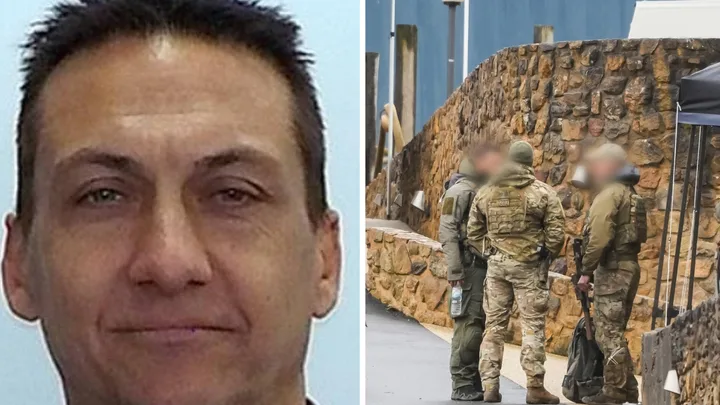
Almost two months have passed since police officers Neal Thompson and Vadim De Waart were killed in Victoria’s High Country, as they searched a ramshackle property belonging to Desmond ‘Dezi’ Freeman. They were executing a warrant when Freeman, 56, allegedly opened fire.
The self-proclaimed sovereign citizen, who is still on the run, is one of a growing number of Australians who refuse to recognise the law and are anti-government, anti-authority and anti-police.

In December 2022, two other police officers were killed at a rural property in Wieambilla in Queensland while responding to a missing person’s report. Constables Rachel McCrow and Matthew Arnold were ambushed at the property of conspiracy theorists Gareth, Nathaniel and Stacey Train.
Nathaniel, 46, Gareth, 47, and Stacey, 45, also all died at the scene. They saw the government and police as evil and corrupt, and believed the end of the world was coming.
Dr Joe McIntyre, Associate Professor of Law at the University of South Australia, says there has been a spike in the number of Australians identifying as sovereign citizens.

“The sovereign citizen movement exploded following COVID and more people began to see the law as a coercive force. Some then went down a rabbit hole with their beliefs becoming stranger and stranger,” he says.
“Sovereign citizens use ‘pseudo-law’ to avoid paying taxes, speeding fines and council rates and pick and choose what laws apply to them. Many of them are alienated and feel excluded and powerless and sovereign citizenship offers them the hope of taking back control.”
Dr Josh Roose, Associate Professor of Politics at Deakin University, believes sovereign citizenship strongholds are mostly found in rural and regional communities where economic disadvantage and a sense of marginalisation fuel anti-authority feeling and contempt.

“Some sovereign citizens live as far away from government as possible by going off-grid. Many of them are older Australians who’ve faced financial hardship and struggle,” he says. “They often feel deep-seated anger, humiliation and shame about something not working in their life and they believe sovereign citizenship offers a solution.”
While it began in the US in the 1970s, sovereign citizenship is on the rise globally and Dr McIntyre says it poses a “big threat”.



“People who are drawn in by ideas of community and belonging can then be drawn into the deeper underbelly of sovereign citizenship,” Dr Roose adds. “We need to be doing a lot more to try and pull people out of that deep, dark space.”